

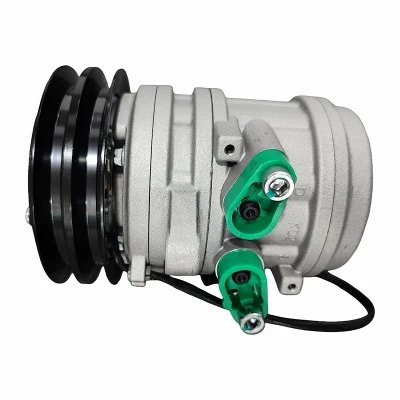
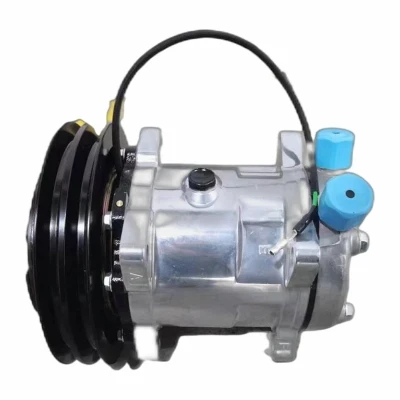
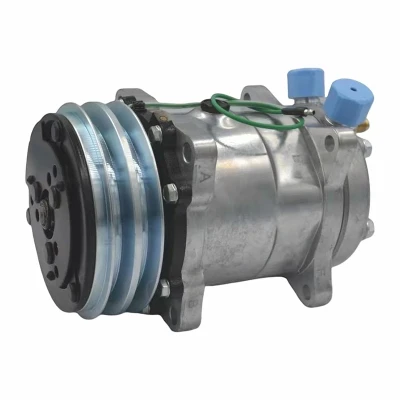
A swashplate compressor gets its name from the swashplate fixed to the main shaft that drives the reciprocating motion of the piston. Because the piston's reciprocating motion is parallel to the drive shaft's centerline, it is also called an axial piston compressor.
A swashplate compressor mainly consists of a swashplate, main shaft, double-acting piston, double-acting cylinder, steel balls, valve plate assembly, cylinder head, and electromagnetic clutch.
The swashplate is fixed to the compressor's main shaft. The edge of the swashplate fits into a groove in the middle of the piston, and the piston groove and the edge of the swashplate are supported by steel ball bearings. When the main shaft rotates, the swashplate rotates as well, and the edge of the swashplate pushes the piston in an axial reciprocating motion. One reciprocating motion of the piston completes the compressor's intake, compression, and exhaust processes. If the swashplate rotates once, the two pistons at the front and rear each complete the intake, compression, exhaust, and expansion processes, equivalent to the action of two cylinders. If the cylinder block cross-section evenly distributes three cylinders and three double-acting pistons, one rotation of the main shaft is equivalent to six cylinders working, hence the name six-cylinder swashplate compressor. Similarly, a ten-cylinder swashplate compressor has five cylinders and five double-acting pistons.
Swashplate compressors lack a crankshaft and connecting rod mechanism, resulting in a compact structure, good balance, and the ability to operate at higher speeds. Compared to oscillating compressors, swashplate compressors are quieter and do not require anti-rotation gear pairs. The pistons are designed for double-acting, with one end drawing in air while the other exhausts, reducing exhaust pulsation and eliminating the need for dynamic balancing.
Swashplate compressors with variable displacement mechanisms exist, where the displacement can be controlled by adjusting the swashplate angle. Their drive mechanism includes an element with an adjustable tilt surface, the angle of which is controlled by the pressure in the connecting rod chamber, achieving stepless variable displacement control.