

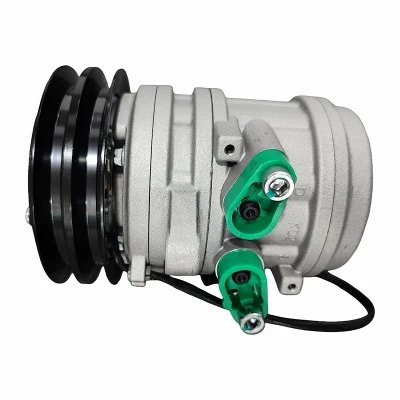
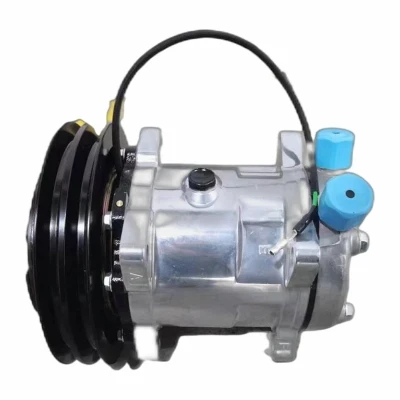
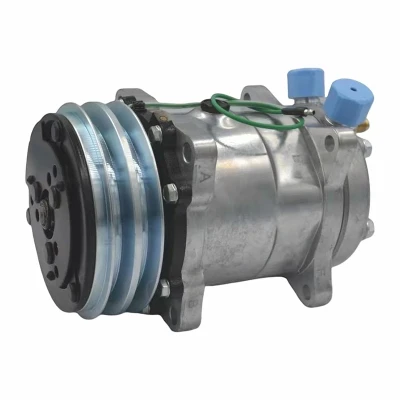
The working principle of a swashplate compressor is as follows: when the main shaft rotates, the fixed swashplate rotates accordingly, pushing the piston along the cylinder axis via a sliding shoe (or ball bearing), thus completing the intake, compression, and exhaust processes. Its core components include the main shaft, swashplate, bidirectional piston, cylinders, and valve plate assembly. Because the piston acts bidirectionally, each piston completes two working cycles per rotation of the swashplate. Therefore, if three cylinders are evenly distributed in the cylinder block, it is equivalent to six cylinders working, hence the name six-cylinder swashplate compressor; if five cylinders are evenly distributed, it is equivalent to ten cylinders working.
This type of compressor has several technical advantages: high efficiency, low noise, and smooth operation. Due to the absence of a crankshaft and connecting rod mechanism, it has a compact structure, small size, and light weight. The bidirectional action of the piston allows its reciprocating inertial force and torque to be completely and naturally balanced, resulting in low vibration. It has a lower cost, making it particularly suitable for small-displacement cars and family sedans. Modern swashplate compressors have achieved stepless variable displacement control. Externally controlled continuously variable displacement (CVD) compressors eliminate the electromagnetic clutch, further reducing overall weight and enabling smoother operation through continuous displacement adjustment, avoiding cyclical load changes in the engine.
The technology of swashplate compressors continues to evolve, with key trends including: achieving miniaturization and lightweighting through material improvements (such as replacing cast iron with all-aluminum) and structural optimization; gradually increasing engine speeds, reaching over 10,000 rpm; and progressing from fixed displacement to internally and externally controlled CFDs for more precise control. The industry is continuously addressing specific problems through research and development, such as adopting new mechanisms (e.g., planetary plate and ball joint pin connections) to improve smoothness, reduce noise, and lower starting torque; and designing additional mechanisms to balance inlet and outlet air velocities and reduce valve wear.
The dynamic analysis of swashplate compressors is a crucial foundation for their design, involving the analysis of key geometric and kinematic relationships such as swashplate tilt angle, piston displacement, velocity, and acceleration, as well as research on reciprocating inertial forces and their torque balancing methods, providing a theoretical basis for optimized design.