

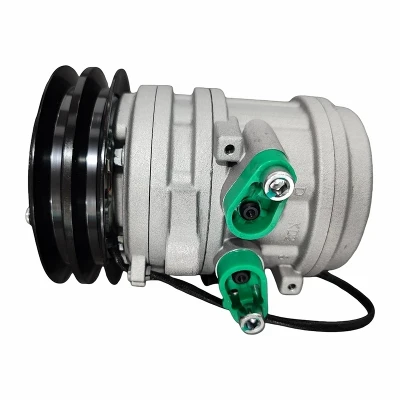
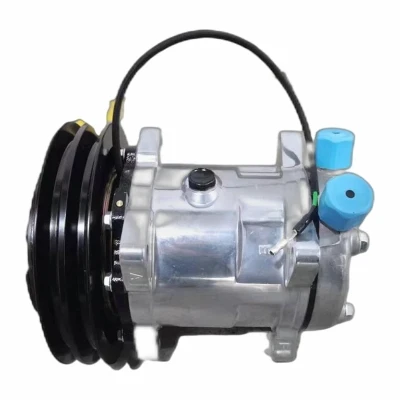
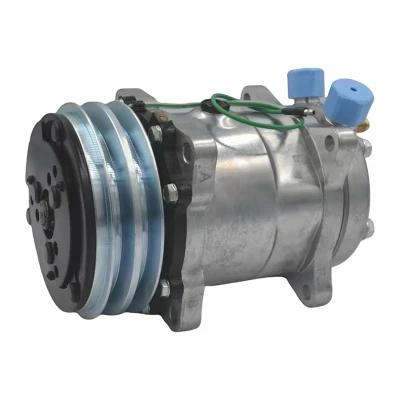
In the dynamic and ever - evolving world of compressor technology, fixed displacement compressors stand as a cornerstone in various industrial and automotive applications. As a trusted supplier of Fixed Displacement Compressors, I am excited to delve into the intricacies of the compression process within these remarkable machines.
Understanding the Basics of a Fixed Displacement Compressor
Before we explore the compression process, it's essential to understand what a fixed displacement compressor is. A fixed displacement compressor has a set volume of refrigerant or gas that it can move with each rotation. Unlike Variable Displacement Swash Plate Compressors, which can adjust their displacement based on the system's needs, fixed displacement compressors operate at a constant capacity.
The Compression Process Step - by - Step
1. Suction Phase
The compression cycle begins with the suction phase. The compressor is connected to the low - pressure side of the refrigeration or gas system. As the compressor's piston moves downward (in a reciprocating compressor, a common type of fixed displacement compressor), it creates a low - pressure area within the cylinder. This low pressure causes the refrigerant or gas to be drawn into the cylinder through the intake valve. The intake valve is designed to allow the fluid to flow in one direction only, preventing backflow.
During this phase, the refrigerant is in a low - pressure, low - temperature state. It is a vapor, and its pressure is typically around 20 - 40 psi (pounds per square inch) in a typical automotive air - conditioning system. The suction phase is crucial as it sets the stage for the subsequent compression of the refrigerant.
2. Compression Phase
Once the cylinder is filled with the refrigerant vapor, the piston starts moving upward. As it does, the volume of the cylinder decreases, and the refrigerant is compressed. According to the ideal gas law, when the volume of a gas is reduced while the amount of gas remains constant, the pressure and temperature of the gas increase.
The compression ratio, which is the ratio of the initial volume to the final volume of the gas in the cylinder, is a key factor in determining the performance of the compressor. In a fixed displacement compressor, this ratio is fixed. As the piston compresses the refrigerant, the pressure can rise significantly, often reaching 150 - 300 psi in an automotive air - conditioning system. The temperature also increases substantially, making the refrigerant a high - pressure, high - temperature vapor.
3. Discharge Phase
After the compression phase, the high - pressure, high - temperature refrigerant vapor is ready to be discharged from the cylinder. As the piston continues its upward movement, it reaches a point where the pressure inside the cylinder exceeds the pressure in the discharge line. At this moment, the discharge valve opens, and the compressed refrigerant is forced out of the cylinder and into the high - pressure side of the system.
The discharge valve, like the intake valve, is a one - way valve. It ensures that the high - pressure refrigerant flows in the correct direction and does not return to the cylinder. The high - pressure refrigerant then moves through the condenser, where it releases heat and begins to condense into a liquid.
4. Re - expansion and Return
After passing through the condenser, the high - pressure liquid refrigerant moves through an expansion device. This device reduces the pressure of the refrigerant, causing it to expand and cool down. The low - pressure refrigerant then returns to the compressor to begin the cycle anew.
Comparison with Variable Displacement Compressors
While fixed displacement compressors have a straightforward and reliable compression process, it's worth comparing them briefly with variable displacement compressors. Variable Displacement Air Compressors and Variable Displacement AC Compressors can adjust their displacement based on the system's requirements. This allows for more precise control of the cooling or gas delivery process and can result in energy savings.
However, fixed displacement compressors have their own advantages. They are generally simpler in design, more robust, and less expensive to manufacture and maintain. In applications where a constant cooling or gas delivery rate is required, fixed displacement compressors are often the preferred choice.
The Role of Swash Plate Mechanism in Some Fixed Displacement Compressors
Many fixed displacement compressors, especially those used in automotive air - conditioning systems, utilize a swash plate mechanism. A Swash Plate Ac Compressor has a swash plate that is connected to the compressor's drive shaft. As the drive shaft rotates, the swash plate moves in an eccentric motion.
This eccentric motion is transferred to the pistons in the compressor. The pistons are connected to the swash plate via connecting rods, and as the swash plate moves, it causes the pistons to move up and down in the cylinders. This up - and - down motion of the pistons is what drives the suction, compression, and discharge phases of the compression process.
Externally Controlled Variable Displacement and Its Contrast
In contrast to fixed displacement compressors, Externally Controlled Variable Displacement Compressors have an external control mechanism that can adjust the compressor's displacement. This control can be based on factors such as the temperature of the environment, the load on the system, or the pressure in the system.
While this provides greater flexibility, it also adds complexity to the compressor design. Fixed displacement compressors, on the other hand, operate independently of external control signals regarding displacement adjustment, making them a more reliable choice in applications where simplicity and durability are key.
Applications of Fixed Displacement Compressors
Fixed displacement compressors are widely used in various applications. In the automotive industry, they are commonly found in older air - conditioning systems, where a constant cooling capacity is sufficient. They are also used in industrial refrigeration systems, small - scale air - compression applications, and some types of heat pumps.
Quality Assurance in Our Fixed Displacement Compressors
As a supplier of Fixed Displacement Compressors, we take pride in the quality of our products. We use high - quality materials in the manufacturing process to ensure the durability and reliability of our compressors. Our production facilities are equipped with state - of - the - art machinery, and our team of experienced engineers and technicians conducts rigorous quality control checks at every stage of production.


We understand that the performance of a compressor is crucial to the overall efficiency of the system it is a part of. That's why we continuously invest in research and development to improve the design and performance of our fixed displacement compressors.
Why Choose Our Fixed Displacement Compressors?
When you choose our fixed displacement compressors, you are choosing a product that is built to last. Our compressors are designed to operate under a wide range of conditions, from extreme temperatures to high pressures. We offer a variety of models to suit different applications, and our technical support team is always available to assist you with any questions or issues you may have.
Contact Us for Procurement
If you are in the market for high - quality Fixed Displacement Compressors, we invite you to contact us for procurement discussions. Our team of experts is ready to work with you to understand your specific requirements and provide you with the best - suited compressor solutions. Whether you are an automotive manufacturer, an industrial refrigeration company, or a small - scale business in need of air - compression solutions, we have the products and expertise to meet your needs.
References
- ASHRAE Handbook of Refrigeration. American Society of Heating, Refrigerating and Air - Conditioning Engineers.
- Compressor Technology Handbook. Schaefer, P.
- Automotive Air Conditioning Systems: Principles and Service. Halderman, J. D.